Help for a Reactive or Aggressive Dog in Los Angeles
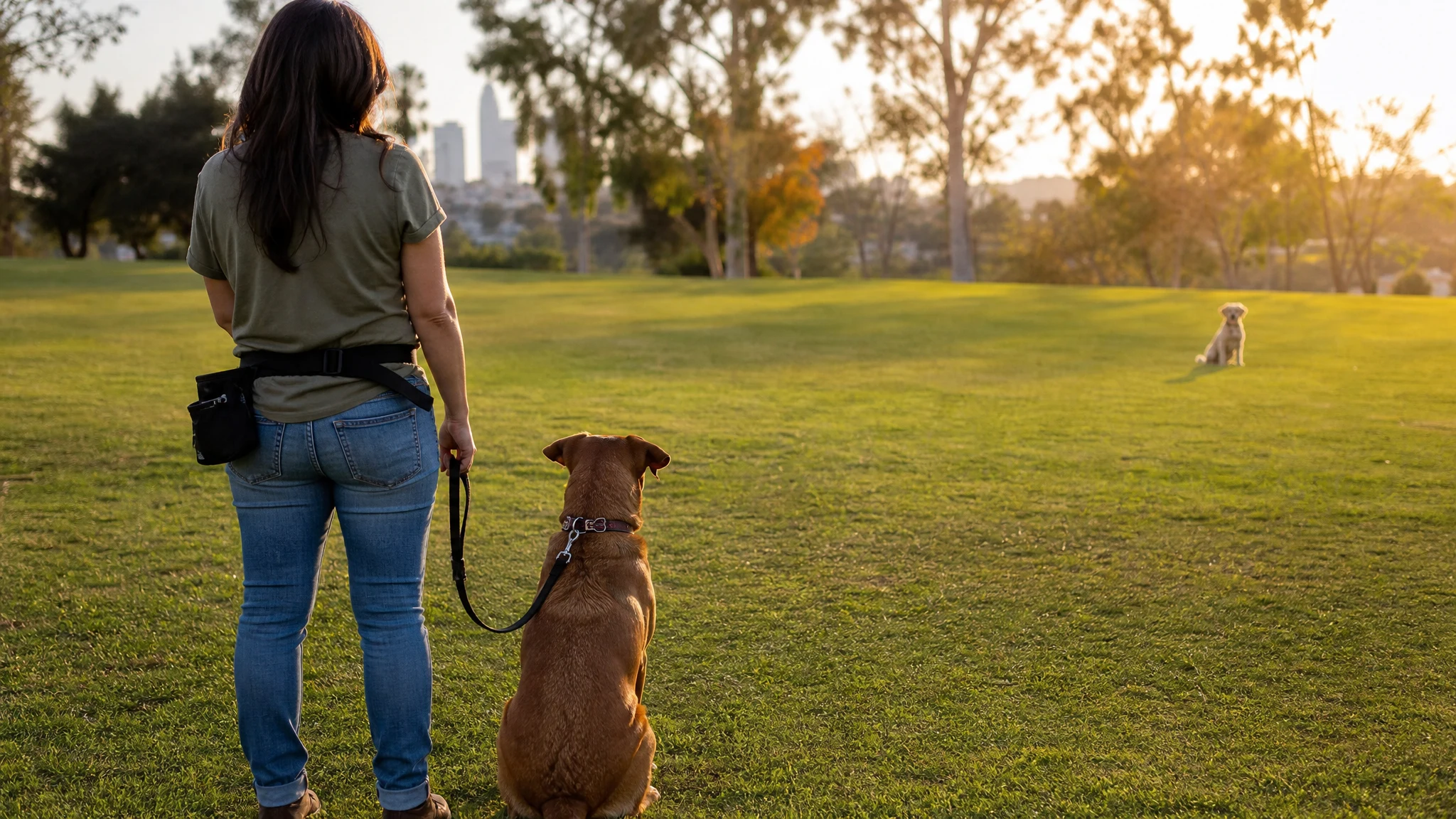
General training information. For aggression, sudden behavior changes or health concerns, see your veterinarian first.
If your dog lunges, barks or growls at other dogs, strangers or bikes, you are not alone, and it does not make you a bad owner. Los Angeles can make it harder. Narrow sidewalks, busy trailheads, apartment hallways and crowded park entrances put triggers close to your dog all day.
This guide covers reactive dog training at home, step by step. It also explains when a dog needs more than a how-to article. If you are weighing outside help, our guide to dog training in Los Angeles, where to train and what it costs covers the wider picture.
What reactivity and aggression mean
A reactive dog overreacts to a specific trigger. The trigger might be another dog, a skateboard, a person in a hat or a delivery truck. The reaction is often barking, lunging, spinning or growling on leash. Many reactive dogs are scared, frustrated or overexcited. They are not "bad" dogs.
Aggression is behavior meant to create distance or cause harm, such as snarling, snapping, air-biting or biting. Reactivity can turn into aggression if the dog feels it has no other choice. The two overlap, but a bite changes the situation. We cover that later in this guide.
Either way, the dog is communicating discomfort. The job is to change how the dog feels about the trigger, not to scold the signal.
Safety first
Before any training, make the daily routine safer for everyone, your dog included.
- Know the leash rule. The Los Angeles Municipal Code (section 53.06.2) says that off the owner's premises a dog must be under the control of a competent person and restrained by a substantial chain or leash not exceeding six feet. The exception is a dog exercise or training area established under LAMC 63.44.
- Skip the dog park for now. The City of Los Angeles Department of Recreation and Parks lists dog park rules that include removal of aggressive dogs. A crowded off-leash area is a hard place to practice, so it is usually a poor starting point for a reactive dog.
- Manage the environment. Close curtains or use window film if your dog barks at passersby. Use a baby gate or closed door when guests arrive.
- Use a well-fitted harness or flat collar and a standard leash. Never use shock, prong or choke collars (more on why below).
- Consider a basket muzzle introduced slowly with treats. A muzzle your dog likes wearing is a safety tool, not a punishment. Ask a trainer to help you introduce it.
Why punishment tends to make it worse
It is tempting to correct a dog that lunges. The American Veterinary Society of Animal Behavior (AVSAB) recommends reward-based training and advises against punishment-based methods. Its position is that aversive methods can increase fear, anxiety and aggression, and can damage the bond between dog and owner.
Here is the logic. If your dog barks at another dog because it is afraid, a leash jerk or a shock adds something unpleasant at the exact moment the other dog appears. The dog may learn that other dogs predict pain. The barking may stop for a while, but the fear can grow. Some dogs also learn to skip the warning growl, which makes a bite more likely.
Alpha rolls, scruffing and "dominance" methods carry the same risk. We do not recommend any of them.
Materials you will need
- A standard six-foot leash (no retractable leash, and nothing longer than six feet on city streets)
- A comfortable, well-fitted harness or flat collar
- Very small, soft, high-value treats such as tiny pieces of cooked chicken or cheese, in a pouch you can reach quickly
- A quiet place at home with few distractions
- A notebook or phone notes to track triggers, distances and your dog's reactions
- Optional: a basket muzzle, once your dog is comfortable wearing it
- Optional: a calm helper dog and handler, positioned far away, once you have some progress
Step-by-step: desensitization and counter-conditioning basics
These two methods are the foundation of most reactive dog training. Desensitization means exposing the dog to a trigger at a level so low that it stays relaxed. Counter-conditioning means pairing that trigger with something the dog loves, so the trigger starts to predict good things.
Step 1: Keep a trigger log for a week
Write down what sets your dog off, how far away it was, what time of day it was and how your dog reacted. Patterns show up quickly. Maybe it is only dogs that stare, or only on your busiest street. This tells you where to start.
Step 2: Find your dog's threshold distance
The threshold is the distance at which your dog notices the trigger but can still take a treat and think. Closer than that, your dog may bark, freeze or ignore food. Training only works under threshold. In Los Angeles, a wide street, a parking lot corner or a quiet cul-de-sac can give you the space.
Step 3: Teach a few easy skills at home first
Practice where it is quiet, with no triggers in sight.
- Name game: Say your dog's name. When your dog looks at you, give a treat.
- Hand target: Hold out your palm. When your dog touches it with their nose, give a treat. This gives you a way to move your dog away calmly.
- "Let's go" U-turn: Say a cheerful cue, turn around and walk away together, then reward.
Aim for short sessions of a few minutes, once or twice a day.
Step 4: Start at a distance where your dog is relaxed
Go out at a quiet time. LA Animal Services recommends walking in the cool of early morning or evening in hot weather, and those hours often have fewer people and dogs too. Stand or walk at a distance where your dog sees a trigger but stays calm.
Step 5: Pair the trigger with treats
The moment your dog sees the trigger, say a happy marker word like "yes" and feed a steady stream of tiny treats. When the trigger moves out of sight, the treats stop. The pattern your dog learns is: trigger appears, good things happen.
Step 6: Watch body language and adjust
A loose, wiggly body and a soft face mean you are in a good zone. A stiff body, hard stare, closed mouth, raised hackles or refusing food means you are too close. Calmly use the U-turn and add distance. This is not failure. It is useful information.
Step 7: Make progress in tiny increments
When your dog stays relaxed at a distance across several sessions, close the gap by a few feet. If the reaction returns, go back to the last easy distance. Progress is rarely a straight line. Some days will be better than others.
Step 8: Practice on a schedule that fits LA life
Short, repeated sessions beat one long outing. Try a quiet loop in your own neighborhood on weekdays, and save busy places like popular trails for later. Keep sessions positive and end on a good note.
Tips for success
- Reward calm, not just the absence of barking. Mark and treat quiet looks at the trigger and relaxed body language.
- Let your dog sniff and decompress before and after sessions. A relaxed dog learns better.
- Advocate for your dog. You can say, "My dog needs space," and move away. Most people understand.
- Protect your own calm. Dogs notice tension on the leash. Breathe, keep the leash loose and keep your voice friendly.
- Keep health basics current. Keep rabies vaccination current as your veterinarian directs. In the City of Los Angeles, a dog license is valid only while the rabies vaccination is current, according to the LAMC (section 53.51).
Common mistakes to avoid
- Flooding. Taking a reactive dog to a crowded place "to get used to it" usually raises stress and can make reactivity worse.
- Using corrections. As explained above, punishment risks more fear and aggression.
- Going too fast. Moving closer after one good day is a common setback.
- Using treats too big or too slow. Large treats take time to chew, and your dog may miss the chance to learn. Use tiny pieces you can deliver quickly.
- Forcing greetings. A leashed "say hello" with an unfamiliar dog is a common trigger. It is fine to walk past.
- Ignoring pain or illness. A sudden change in behavior can have a medical cause, as covered next.
When to see a veterinarian or a veterinary behaviorist
Start with your regular veterinarian if the behavior is new, sudden or getting worse. Pain, illness, hormone problems and other medical issues can cause irritability or aggression. A vet visit rules out physical causes and can start a safe plan.
If your dog shows aggression toward people, including growling, snapping or biting, see a veterinarian and a certified behavior professional. Do not try to handle it with a how-to guide alone. Keep everyone safe in the meantime by managing space, using barriers and avoiding situations that trigger the behavior.
Some cases need a veterinary behaviorist, who is a veterinarian with advanced training in behavior and can consider medication alongside training. The practices below describe themselves as board-certified veterinary behaviorists (DACVB). Contact each practice directly to confirm services, availability and fees.
- Karen Sueda, DVM, Karen Sueda Veterinary Behavior Inc., which offers housecalls throughout Los Angeles County. The practice website describes Dr. Sueda as a board-certified veterinary behaviorist.
- Rachel Malamed, DVM, DACVB, based in Los Angeles, with virtual and in-person appointments.
Finding a certified trainer in Los Angeles
For reactive dogs, look for a trainer who uses reward-based methods and has experience with fear and aggression. The Certification Council for Professional Dog Trainers (CCPDT) directory lists these certified professionals in Los Angeles. CPDT-KA is a general trainer certification. CBCC-KA is the CCPDT behavior consultant credential, which suits behavior problems.
- Katherine (Kate) Anderson, Moondog Dog Training, CPDT-KA and CBCC-KA, Los Angeles 90031
- Jessica Leigh Gore, Competent Pup, CPDT-KA and CBCC-KA, Los Angeles 90038
- William Sean Miller, Willful Dogs, CPDT-KA and CBCC-KA, West LA 90034
- Kristin N. Burke, Cognitive Dogs, CBCC-KA, Los Angeles 90018
- Kim Kurland, PAWSitive Hound Dog Training, CPDT-KA, serving the San Fernando Valley and surrounding areas of Los Angeles
- Caryl R. Wolff, Doggie Manners, CPDT-KA, Los Angeles 90025
- Jeffrey Dauber, Chutzpaws Dog Training, CPDT-KA, Los Angeles 90025
- Elisha A. Stynchula, "I Said Sit!" School for Dogs, CPDT-KA, 3368 S. Robertson Blvd, Los Angeles 90034
- Russell Hartstein, Fun Paw Care, CPDT-KA, Los Angeles 90064
- Jocelyn A. Walls, Muttineer, CPDT-KA, Los Angeles 90041
This is a list of credentials, not a ranking or a recommendation. Ask any trainer about their methods before you book. Look for someone who will not use shock, prong or choke collars or dominance methods. Check each trainer's website for services, fees and current availability.
The Los Angeles dangerous dog rule
It helps to know how the city handles biting. Under LAMC section 53.34.4, after a hearing, LA Animal Services may declare a dog dangerous if it has bitten, attacked or caused injury to a person or animal. The code weighs factors such as the dog's prior history, the injuries, provocation and whether the dog can be retrained.
The code also says that keeping a dog declared dangerous is unlawful and provides for its surrender and destruction. If a dog is found not dangerous but the incident came from improper training or handling, the license can be revoked or reissued with conditions. Reports go to the nearest LA Animal Services center.
This is why early help matters. If your dog is escalating, getting a veterinarian and a certified behavior professional involved now is safer for your dog and for the people around them. If you have questions about a specific incident, contact LA Animal Services directly, and consider getting legal advice.
The number of dogs per household also matters when you are managing a tense home. LA Animal Services lists a limit of three dogs over four months of age per premises, and four or more makes a premises a dog kennel that needs a permit.
What results to expect
Every dog is different, so no one can promise an outcome. Many owners find that with steady, reward-based practice, their dog may recover faster after a trigger, bark less and tolerate closer distances over weeks to months. Some dogs improve a lot, while others do best with ongoing management such as space, routines and a muzzle in certain situations.
Count small wins: a longer look back at you, a quicker recovery, one more block walked calmly. Progress can slip during stressful periods, so go back a step when you need to.
Quick recap
- Make walks and home life safer with a six-foot leash, distance and barriers.
- See your veterinarian first, especially if the behavior is new or sudden.
- Log triggers and find your dog's threshold distance.
- Teach easy skills at home, then pair triggers with tiny treats from far away.
- Increase difficulty slowly, and back up when your dog tells you to.
- For aggression toward people, work with a veterinarian and a certified behavior professional.
Sources
- Los Angeles Municipal Code, SEC. 53.06.2 Restraint of Dogs
- Los Angeles Municipal Code, SEC. 53.34.4 Dangerous Animal - Procedures
- LA Animal Services, Licenses page
- LA Animal Services, Hot Weather Pet Safety Tips
- City of Los Angeles Department of Recreation and Parks, Dog Parks page
- Karen Sueda Veterinary Behavior Inc., Dr. Sueda
- Dr. Rachel Malamed, behaviordogtor.com
- CCPDT certified dog trainer directory, Kate Anderson profile
- CCPDT certified dog trainer directory, Jessica Leigh Gore profile