Off-Leash Dog Parks in Los Angeles and How to Train for Them
General training information. For aggression, sudden behavior changes or health concerns, see your veterinarian first.
An off-leash dog park can be a great outlet for an Angeleno dog with energy to spare. It can also go wrong fast if the dog can't come when called, can't ignore a rude stranger, or doesn't know how to leave a game.
This guide covers the dog parks Los Angeles Recreation and Parks lists, the rules they share, and a step-by-step plan to get your dog ready. It also covers when a dog park is simply not the right fit.
What You Need Before You Start
- A flat collar with ID tags, plus your dog's current Los Angeles license tag.
- A standard leash no longer than six feet, and a long line (15 to 30 feet) for practice in open spaces.
- Small, soft, high-value treats for practice sessions away from the park.
- A favorite toy and a water bottle with a collapsible bowl.
- Proof of rabies vaccination and your vet's guidance on other vaccines.
- A quiet practice space: your yard, a hallway, or an empty corner of a neighborhood park.
- About 5 to 10 minutes a day. Short, happy sessions work better than long ones.
The Off-Leash Dog Parks Los Angeles Lists
The City of Los Angeles Department of Recreation and Parks lists these off-leash dog parks on its Dog Parks page. If you're looking for an off leash dog park near Los Angeles proper, start here. Hours and fees were not shown on the listing, so check with Recreation and Parks before you go.
| Park | Address or location |
|---|---|
| Eagle Rock Dog Park | 1100 Eagle Vista Drive, Los Angeles, CA 90041 |
| Glen Alla Dog Park | 4601 Alla Rd., Marina Del Rey, CA 90292 |
| Griffith Park Dog Park | North end of the John Ferraro Soccer Field on North Zoo Drive, Los Angeles, CA 90027 |
| Hermon Park in the Arroyo Seco Dog Park | 5566 Via Marisol, Los Angeles, CA 90042 |
| Laurel Canyon Dog Park | 8260 Mulholland Dr, Los Angeles, CA 90046 |
| Runyon Canyon Dog Park | 2000 N Fuller Avenue, Los Angeles, CA 90046 |
| Sepulveda Basin Off-Leash Dog Park | 17550 Victory Blvd., Encino, CA 91406 |
| Silverlake Dog Park | 1863 Silver Lake Blvd, Los Angeles, CA 90026 |
| Westminster Dog Park | 1234 Pacific Avenue, Venice, CA 90291 |
| Whitnall Off-Leash Dog Park | 5801 1/2 Whitnall Highway, North Hollywood, CA 91601 |
For current details, see the Recreation and Parks Dog Parks page.
The Rules That Apply at These Parks
According to the Recreation and Parks Dog Parks page, the same rules apply across the listed parks:
- No dogs under four months old.
- Dogs over four months must be fully vaccinated, licensed and spayed or neutered, and must wear a collar and tags.
- Dogs must be leashed in the parking area.
- No food or treats inside the park.
- Aggressive dogs are removed.
That last point about treats matters for training. You can't count on a pocketful of cheese to call your dog away from a game inside the gate. Build the skills below elsewhere first, then lean on praise, play and a quick release back to fun at the park.
Two more city rules are worth knowing. The Los Angeles Municipal Code (section 53.06.2) says that off an owner's premises, a dog must be under the control of a competent person and on a leash no longer than six feet, unless the dog is in a dog exercise or training area established under the code. Your dog's leash needs to be on until you are inside the dog park gate.
LA Animal Services also licenses dogs over four months old in the city, and the license is valid only with a current rabies certificate. Its Licenses page lists an altered-dog license at $20 for one year or $55 for three years, on a fee schedule dated October 2010. Check the page for current fees. If your dog is not spayed or neutered, ask LA Animal Services and Recreation and Parks how the intact-dog license and the park rules fit together before you plan a visit.
Step-by-Step: Training Your Dog for Off-Leash Parks
Step 1: Check health and age first
Confirm with your vet that your dog is old enough and vaccinated. California's Health and Safety Code section 121690 requires rabies vaccination once a dog is three months or older, at intervals the state health department sets, so keep it current as your vet directs.
Also ask about canine influenza. LA County Veterinary Public Health's March 2026 advisory strongly recommends H3N2 vaccination before boarding, daycare, dog parks or group activities. A puppy under four months can't go to these parks anyway, so use that time for the foundation work below.
Step 2: Teach a rock-solid recall
Recall is the skill that matters most. Pick one cue word, such as "Here," and use it only for coming to you.
- Start indoors. Say the cue once in a happy voice, then reward the instant your dog arrives with a treat and praise.
- Move to the yard. Practice at short distances, then add distance a few feet at a time.
- Graduate to a long line in a quiet park. Call, reward, then release your dog to go sniff again. Coming back should not mean the fun ends.
- Add mild distractions: a toy on the ground, then a person walking by at a distance.
Never call your dog to scold or end the fun every time. If you need to leash up, call, reward, leash, and sometimes release again before leaving.
Step 3: Build check-ins
A dog who looks back at you on their own is a dog you can manage in a busy park.
- Stand in a quiet spot with your dog on a long line.
- Each time your dog glances at you, say "Yes" and reward.
- Gradually practice with more going on around you, such as a sidewalk with foot traffic.
- Over several weeks, reward the check-ins more randomly and add praise and play in place of treats. This prepares you for the no-treats rule at the park.
Step 4: Practice reading play
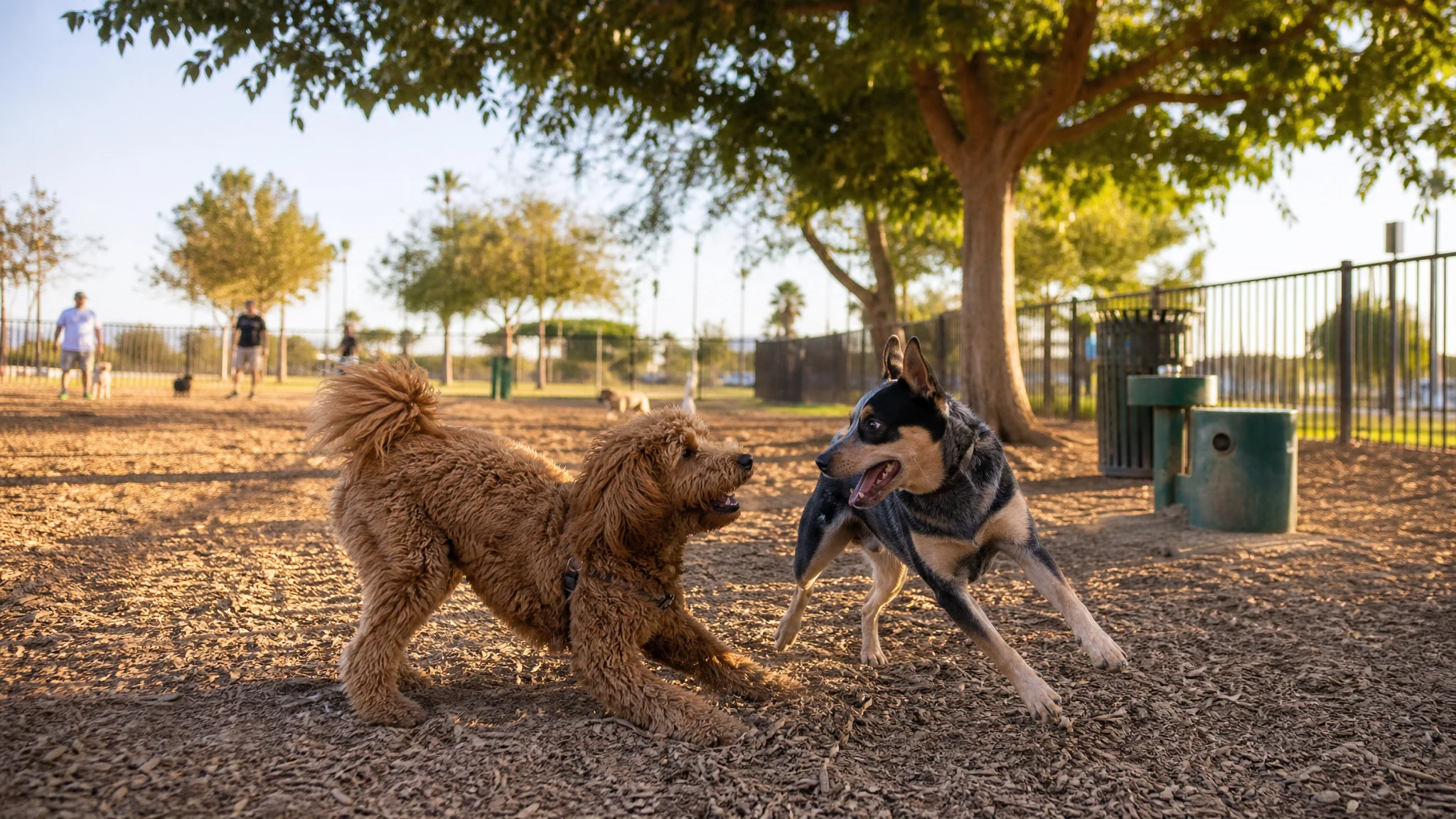
Learn what healthy play looks like before you go. Loose, bouncy bodies, play bows, and taking turns chasing chasing and being chased are good signs. Stiff bodies, hard staring, hackles up, a tucked tail and trying to hide behind you suggest a dog who needs space.
Watch from outside the fence first, or with friends' calm dogs. Ask yourself, "Is everyone enjoying this?" If one dog keeps being pinned, mounted or chased while trying to get away, step in calmly, call your dog, and give everyone a break.
Step 5: Teach calm leaving
Leaving the park is often where trouble starts. Practice it in advance.
- Teach a "Let's go" cue on leash: say it, step away, and reward when your dog turns with you.
- Practice during play with a friendly, calm dog: pause the game, call your dog, reward, then release back to play.
- When you do leave, do it before your dog is overtired. End on a good note.
Step 6: Practice the gate routine
Dogs rushing through a gate can start fights or get overexcited. At home or in a quiet place, practice sitting calmly before you open a door or gate, then walk through together. At the park, keep your dog leashed in the parking area as required, enter calmly, and unclip once you're inside.
Step 7: Do a short first visit
Go at a quiet time and plan on 10 to 15 minutes. Because hours and crowds are not listed on the Recreation and Parks page, a first look in person tells you more. Stay near your dog, keep your recall cue handy, and leave if the mood changes. A calm first visit builds confidence for both of you.
Los Angeles Hazards to Plan Around
- Heat. LA Animal Services advises walking in the cool of early morning or evening and keeping dogs off hot asphalt, concrete, artificial grass and sand. Leaving an animal in a vehicle in dangerous conditions is illegal in California. Flat-faced breeds are at higher risk.
- Coyotes. LA Animal Services says coyote attacks on pets mostly involve pets under 20 pounds. If you see one, keep your dog close, move toward an active area, and never let pets interact with coyotes.
- Rattlesnakes. The City of Los Angeles says rattlesnakes are present year-round and most active in spring and summer. Keep dogs on a short leash outdoors, including on the trails near some parks.
- Valley fever. LA County Veterinary Public Health says this soil fungus is most common in the San Fernando Valley and high desert areas. Coughing is the most common sign in dogs. Avoid stirring up dust, and call your vet if your dog develops a cough.
- Bats and rabies. LA County Veterinary Public Health says bats are the animals most often found with rabies in the county. Keep your dog's rabies vaccine current.
Tips and Common Mistakes
- Skipping the long line. A dog who has never recalled with distractions won't suddenly do it at a busy park.
- Treating the park as the training place. The park is the test, not the classroom.
- Using the park to burn off a high-energy young dog. A tired but overexcited dog is more likely to be pushy. Walk or play first.
- Staring at your phone. Be ready to step in early and calmly.
- Bringing treats inside. The park rules say no food or treats, so do not carry them in.
- Punishing a late recall. If your dog finally comes, reward it. Punishment teaches them not to come back.
- Using harsh tools or rough handling. The American Veterinary Society of Animal Behavior recommends reward-based training. Shock, prong and choke collars, alpha rolls and scruffing can increase fear and aggression.
When a Dog Park Is Not Right for Your Dog
Dog parks aren't for every dog, and that is okay. Skip them, or wait, if your dog:
- is under four months old, which the park rules do not allow;
- is not yet vaccinated, licensed, or spayed or neutered as the rules require;
- freezes, hides, or tries to leave when other dogs approach;
- guards toys, water or you from other dogs;
- cannot yet come away from distractions;
- is still coughing, sneezing or recovering from illness.
Good alternatives include structured walks with one calm dog friend, long-line sniff walks, and group classes. For costs and where to train, see our guide to dog training in Los Angeles.
For puppies, a class can be a safer social setting than a park. As one example, "I Said Sit!" School for Dogs lists its puppy class vaccine requirements on its registration page, which include at least two boosters of parvovirus and distemper. Check with any school you are considering.
If your dog growls, lunges or bites people or other dogs, the dog park is not the place to work on it. Talk with your veterinarian first, since pain and illness can change behavior. If aggression toward people is part of the picture, ask your vet about a certified behavior professional. Los Angeles has veterinary behaviorists, including Karen Sueda, DVM, who does housecalls throughout Los Angeles County, and Rachel Malamed, DVM, who is based in Los Angeles and offers virtual and in-person appointments. Both describe themselves as veterinary behaviorists on their practice sites.
Also note that under the Los Angeles Municipal Code (section 53.34.4), LA Animal Services can hold a hearing and declare a dog dangerous after it has bitten or attacked a person or animal. A calm, controlled setup prevents problems for everyone.
What Results to Expect
With steady daily practice, many owners find their dogs come back faster and check in more often within a few weeks. Results depend on the dog's age, history and temperament, and some dogs need months of practice.
If progress stalls, go back a step, practice in a quieter place, or bring in a trainer. Keep sessions short and upbeat, and remember that a dog who prefers a long-line hike to a crowded fence is not failing.
Sources
- City of Los Angeles Department of Recreation and Parks, Dog Parks page
- Los Angeles Municipal Code, Sec. 53.06.2 Restraint of Dogs
- Los Angeles Municipal Code, Sec. 53.34.4 Dangerous Animal Procedures
- LA Animal Services, Licenses page
- California Health and Safety Code section 121690
- LA County Veterinary Public Health, Canine Influenza H3N2 advisory (March 4, 2026)
- LA Animal Services, Hot Weather Pet Safety Tips
- LA Animal Services, Wildlife Resources
- City of Los Angeles, Rattlesnakes in L.A.: What You Need to Know
- LA County Veterinary Public Health, Valley Fever
- LA County Veterinary Public Health, Rabies
- "I Said Sit!" School for Dogs, Register page