How Much Does Dog Training Cost in Los Angeles?
General training information. For aggression, sudden behavior changes or health concerns, see your veterinarian first.
If you are asking how much dog training costs in Los Angeles, the honest answer starts with a caveat. Most trainers here do not post their rates online, and the ones who do charge for very different things. A six-week puppy class and a multi-week board-and-train program are not the same product, so they do not share a price.
This guide walks you through the process of pricing out dog training in Los Angeles. It uses only prices that two local businesses publish on their own websites. We do not give a citywide average, because the published numbers are too few to support one. Use the steps below to gather real quotes for your own dog.
Dog Training Prices Published in Los Angeles
Here is what two Los Angeles businesses list publicly. Each price is tied to the business and the exact service, so you can see what you would be paying for.
| Business | Service | Published price |
|---|---|---|
| "I Said Sit!" School for Dogs | Group class: Puppy Preschool (6 in-person 1-hour sessions plus online orientation; puppies under 20 weeks) | $275 |
| "I Said Sit!" School for Dogs | Group class: Puppy Playgroup (4 sessions, 45 minutes each) | $150 |
| "I Said Sit!" School for Dogs | Group class: Adult Manners (dogs over 20 weeks, 6 sessions) | $275 |
| "I Said Sit!" School for Dogs | Private session: one-hour new-student consultation | $200 |
| "I Said Sit!" School for Dogs | Board-and-train: GED program (dogs over 20 weeks) | $4,500 to $5,580 |
| Doggie Manners (Caryl Wolff) | Private in-home training, primary service area: first lesson (about 1.5 hours) | $325 |
| Doggie Manners (Caryl Wolff) | Private in-home training: each hour after the first lesson | $225 per hour |
| Doggie Manners (Caryl Wolff) | Private in-home training: package of 3 lessons, 1.5 hours each | $800 |
These figures come from the "I Said Sit!" School for Dogs group class, private training and boarding school pages, and from the Doggie Manners website. Prices change, so confirm the current rate with the business before you plan around it.
That is all we can responsibly list. Many other Los Angeles trainers do not publish rates, and for those, the only way to learn the cost is to contact them. For a wider look at where to train in the city, see our guide to dog training in Los Angeles, where to train and what it costs.
What You Need Before You Start
- Your dog's age, and a short list of what you want to change (for example, leash pulling, jumping, or a puppy who needs basics).
- Your dog's vaccination records, including rabies, from your veterinarian.
- Your dog's City of Los Angeles license, if you live in the city.
- A notepad or phone note to record each quote, what it includes, and how many sessions it covers.
- A realistic sense of your schedule. Weekday daytime classes, evening groups and in-home visits all price and work differently.
Step 1: Decide What You Want Training to Fix
Price follows purpose. A puppy learning to settle, sit and walk on a leash is a different job than an adult dog who panics when people visit. Write down two or three specific goals.
Be specific. "Walk calmly past other dogs on my street" is something a trainer can quote against. "Be a good dog" is not.
If your goal involves growling, snapping or biting, pause here. Aggression toward people is not a routine training job. See your veterinarian first to rule out pain or illness, then work with a certified behavior professional. We cover that near the end of this article.
Step 2: Pick a Training Format, Because Format Drives Price the Most
In the published Los Angeles prices above, format is the biggest difference, so choose it deliberately.
Group classes
Group classes cost the least per session. "I Said Sit!" School for Dogs lists Puppy Preschool at $275 for six one-hour in-person sessions plus an online orientation. That works out to roughly $46 per in-person session, before you count the online part. Its Puppy Playgroup is $150 for four 45-minute sessions, and its Adult Manners class is $275 for six sessions.
Groups suit basic manners and socialization. The trade-off is less individual attention, and a busy room can be hard for a nervous dog.
Private sessions
Private training costs more per hour because the trainer's time is yours alone. "I Said Sit!" lists a one-hour new-student consultation at $200. Doggie Manners lists a first in-home lesson of about 1.5 hours at $325 in its primary service area, then $225 per hour after that, or a package of three 1.5-hour lessons for $800.
The package works out to about $267 per 1.5-hour lesson. That is less than the $325 first lesson, which is a good reason to ask any trainer whether a package changes the math.
Board-and-train
This is the most expensive format by a wide margin. "I Said Sit!" lists its GED board-and-train program for dogs over 20 weeks at $4,500 to $5,580. We do not know what is included at each price point, so ask the school directly about the length of stay, daily routine, and how handoff lessons work.
With board-and-train, your dog is away from you, so ask how skills will transfer to your home. You will still need to practice with your dog after pickup.
Step 3: Look at Trainer Credentials
Credentials are one reason prices vary, and in California anyone can call themselves a dog trainer. The Certification Council for Professional Dog Trainers (CCPDT) keeps a public certificant directory, which is a useful place to confirm a credential rather than taking it on faith.
CCPDT's directory lists these Los Angeles trainers, among others:
- Caryl R. Wolff of Doggie Manners (Los Angeles, CA 90025) holds CPDT-KA.
- Elisha A. Stynchula of "I Said Sit!" School for Dogs (3368 S. Robertson Blvd, Los Angeles, CA 90034) holds CPDT-KA.
- Katherine (Kate) Anderson of Moondog Dog Training (Los Angeles, CA 90031) holds CPDT-KA and CBCC-KA. CBCC-KA is the CCPDT behavior consultant credential.
- Jessica Leigh Gore of Competent Pup (Los Angeles, CA 90038) holds CPDT-KA and CBCC-KA.
We list these for credential reference only. They are not rankings or recommendations, and for most of them we do not have a published price. Contact each trainer for current rates.
A credential does not automatically mean a higher or lower price. It is one factor to weigh alongside experience, format and your dog's needs.
Step 4: Ask Every Trainer the Same Questions
When you contact a trainer, ask the same questions each time so quotes are comparable:
- What exactly does the price include, and how many sessions and how many minutes each?
- Are there extra fees for travel, materials, an intake call or a follow-up?
- What training methods do you use? Look for reward-based answers. The American Veterinary Society of Animal Behavior (AVSAB) advises against aversive methods such as shock, prong and choke collars, and dominance-based techniques.
- What is your cancellation and make-up policy?
- What happens if my dog is not progressing the way we both hoped?
A trainer who explains their approach plainly and welcomes questions is a good sign. A trainer who cannot say what you are paying for is a reason to keep looking.
Step 5: Add Up the Costs Around the Training
Training fees are not the whole bill. Check these before you commit.
Vaccines and vet records
Many classes require them. "I Said Sit!" School for Dogs, for example, asks for at least two parvovirus and distemper boosters for puppies, Bordetella, rabies for all dogs over 6 months, and a fecal test result from your vet. It recommends leptospirosis and influenza vaccines. The vet visit costs are not published by the school, so ask your veterinarian.
California Health and Safety Code section 121690 requires rabies vaccination once a dog is three months old, by a licensed veterinarian. Follow your vet's schedule for keeping it current.
City dog license
Dogs over four months old kept in the City of Los Angeles need a license from LA Animal Services. Its published fee schedule, labeled as of October 2010, lists $20 for one year or $55 for three years for an altered dog, and $10 for low-income seniors or disabled owners. No fee for unaltered dogs is printed on that page, so check with LA Animal Services if your dog is not spayed or neutered. A license is valid only with a current rabies certificate.
Gear
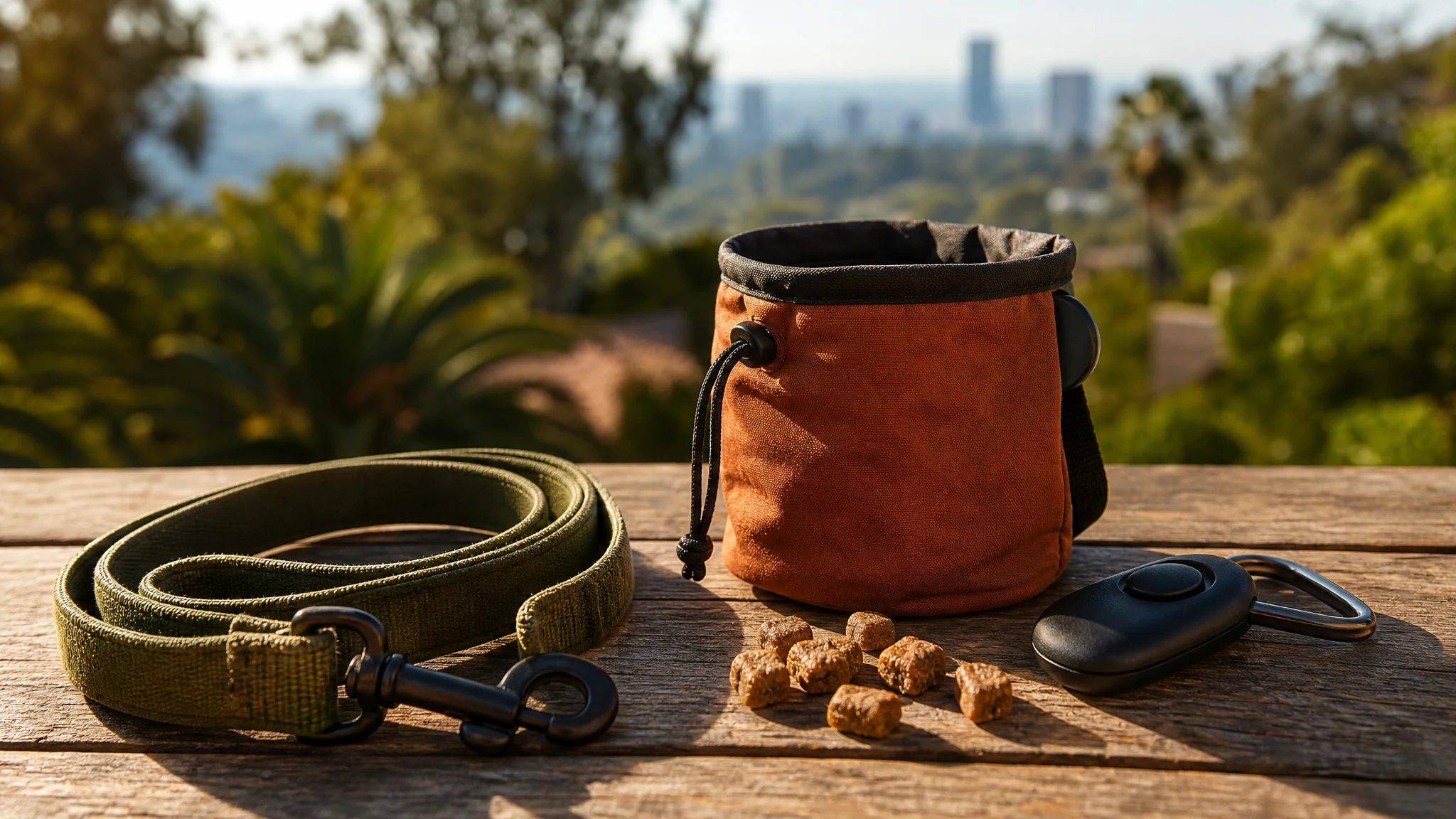
You will want a flat collar or a well-fitted harness, a leash no longer than six feet, and small soft treats. The Los Angeles Municipal Code (section 53.06.2) limits leashes to six feet off your own property, outside areas set up for exercise and training. Prices for gear vary by store and we do not quote them.
Step 6: Compare Total Cost, Not Sticker Price
Put your notes side by side and compare these figures for each option:
- Total price for the full program.
- Number of sessions and length of each.
- Whether it is one-on-one, a small group, or board-and-train.
- What homework you will do between sessions.
- Extra costs such as vaccines, travel or gear.
A cheaper class that does not address your goal can cost more in the end than a pricier option that does. Match the format to the problem first, then compare prices inside that format.
Step 7: Plan Your Practice Time
Training time with a professional is only part of it. Most of the learning happens in the daily minutes you spend with your dog. Short sessions of a few minutes, several times a day, with rewards for the behavior you want, tend to work better than one long session.
If you plan to practice at a City dog park, know the Recreation and Parks rules first. The Department of Recreation and Parks says dogs under four months are not allowed, and dogs over four months must be fully vaccinated, licensed, spayed or neutered, and wearing a collar and tags. Hours and fees are not listed on the department's dog parks page, so check with the department.
LA County Veterinary Public Health strongly recommends canine influenza H3N2 vaccination before boarding, daycare, dog parks or group activities. That includes group classes in many cases, so ask your vet what is right for your dog.
Tips for Getting the Most for Your Money
- Start early with puppies. Puppy classes cost less than most other formats in the published prices, and they build basic skills.
- Ask about packages. As the Doggie Manners numbers show, a package can cost less per lesson than paying one lesson at a time.
- Watch a class first, if allowed. Seeing how a trainer handles dogs tells you more than a website does.
- Ask for the price in writing. It keeps the details clear for both sides.
- Do the homework. The skills only stick if they are practiced at home.
Common Mistakes to Avoid
- Choosing on price alone. The cheapest option is not a bargain if it does not match your dog's needs.
- Assuming a high price means better results. Price tells you about format and time, not your dog's outcome.
- Skipping the methods question. Ask how the trainer works. Avoid anyone who recommends shock, prong or choke collars, alpha rolls, scruffing or dominance methods.
- Forgetting the extras. Vet visits, the license and gear add up.
- Expecting a quick fix. Behavior changes over weeks, not overnight.
- Using a quoted average from a website. Without published local data behind it, an average can mislead you. Get real quotes.
When Training Is Not the Right First Step
Sudden behavior changes, signs of pain, or anything that looks like a medical problem call for your veterinarian first. If your dog has bitten, lunged at or threatened people, see your veterinarian and then a certified behavior professional.
Two veterinary behaviorists who are listed as DACVB on their own practice sites are Karen Sueda, DVM (house calls throughout Los Angeles County) and Rachel Malamed, DVM (virtual and in-person appointments, based in Los Angeles). We do not have published prices for either, so contact the practices for fees.
Also know that the Los Angeles Municipal Code (section 53.34.4) allows LA Animal Services to declare a dog dangerous after a hearing, if it has bitten or attacked a person or animal. Getting help early matters.
What to Expect
Results depend on your dog's age, history and temperament, and on how consistently you practice. With reward-based training and regular practice, many owners see their dogs get better at basic skills such as sit, loose-leash walking and settling over a few weeks. Some dogs may take longer, and some behaviors may need ongoing work. No trainer can promise a particular outcome.
Many owners find that clear goals, a format that fits their dog, and steady practice at home make the biggest difference.
Sources
- "I Said Sit!" School for Dogs, group classes
- "I Said Sit!" School for Dogs, private training
- "I Said Sit!" School for Dogs, boarding school
- "I Said Sit!" School for Dogs, registration requirements
- Doggie Manners
- CCPDT certificant directory, Caryl R. Wolff
- CCPDT certificant directory, Elisha A. Stynchula
- CCPDT certificant directory, Katherine Anderson
- CCPDT certificant directory, Jessica Leigh Gore
- LA Animal Services, Licenses page
- Los Angeles Municipal Code, Sec. 53.06.2, Restraint of Dogs
- Los Angeles Municipal Code, Sec. 53.34.4, Dangerous Animal Procedures
- California Health and Safety Code section 121690
- City of Los Angeles Department of Recreation and Parks, Dog Parks
- LA County Veterinary Public Health, Update on Canine Influenza H3N2 (March 4, 2026)
- Karen Sueda Veterinary Behavior Inc.
- Dr. Rachel Malamed